
STRONG ROOTS INITIATIVE
STRONG ROOTS INITIATIVE

Assisted Migration
Overview
Trees, like humans, have adaptations that allow them to thrive and reproduce under certain environmental and climatic conditions. Climate change is bringing rapid changes to the environment, including new temperature ranges, drought, and new precipitation regimes. For some trees, the rate of climate change far exceeds their ability to adapt. Assisted migration - the human-assisted movement of species to more suitable habitats in response to climate change - is being used to address this challenge.
When comparing human adaptations with those of trees, the key difference lies in the timescale of adaptation. Humans can quickly adjust behaviors and technology in response to climate conditions, but trees adapt over generations. Trees do migrate naturally through dispersal of seeds, but the process is very slow — with distance limited to how far seeds can travel by wind, water, or hitching a ride with another creature. Assisted migration “speeds up” the migration of trees and gives species a chance to thrive and regenerate in locations where projected conditions are more suitable.
Forms of Assisted Migration
Assisted migration includes several different forms which vary in terms of risk, ecological implication, and policy. The most common forms of assisted migration are shown in figure 1.
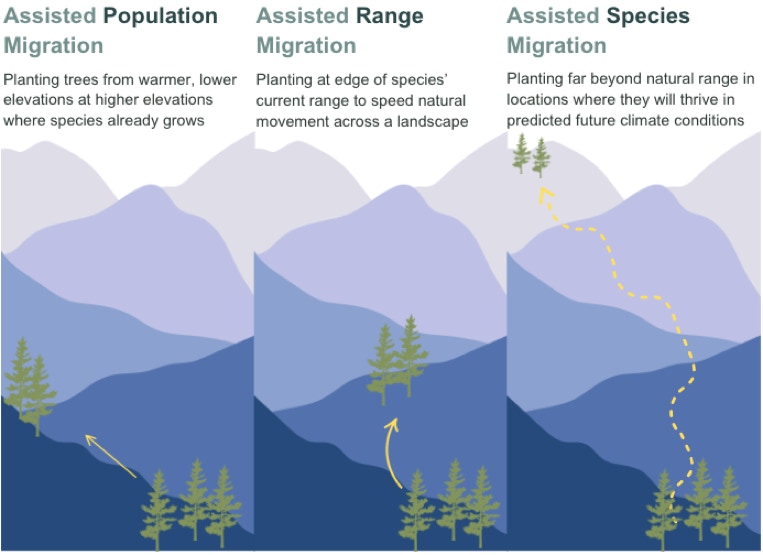
Figure 1: Types of Assisted Migration. Dependent on conditions, location and other factors, different approaches are used to help migrate species.
The idea of moving species beyond their current range may cause hesitation, but in the era of climate change the idea of “native” species is more nuanced. Ranges, species, and entire forest types are shifting, thus our understanding of native species is also changing. Typically, native species have been defined by their geographic range, but current ranges of species are not the same as they once were. As the climate warms rapidly, each snapshot in time results in a slightly different list of species native - or currently present - in each region. Matching species to their ideal conditions in order to avoid extinction is more important than adhering to strict boundaries of historical geographic range as regional climates change.
Background and Research
Additional Resources for Landowners
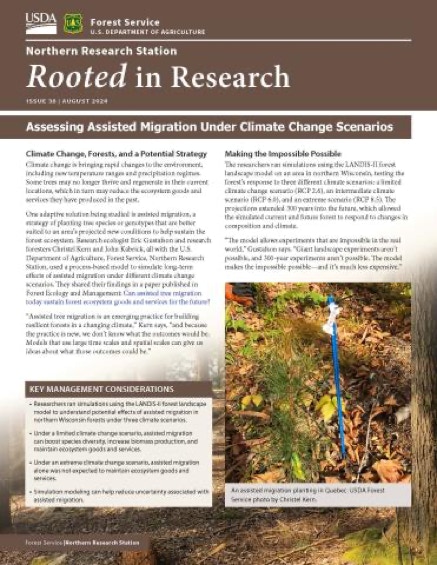
Assisted migration strategies are based in multiple disciplines, including environmental history and scientific research. Most recently, research ecologist Eric Gustafson and research foresters Christel Kern and John Kabrick, all with the USDA’s Forest Service, simulated long-term effects of assisted migration and shared their findings in a paper published in August, 2024 (figure 1).
Tree species are already shifting in response to climate change - moving higher in elevation, or east-west to find moisture. Recent reports from the National Forest Foundation demonstrate that western trees are climbing in elevation and in search of more water, and nearly three quarters of tree species native to eastern forests have moved their population westward since 1980. Instead of seeking colder temperatures, some deciduous trees are seeking increased precipitation, migrating to the central U.S.
Certainly, changes in climate are nothing new for trees. Ice ages have come and gone, mass extinctions have occurred, and trees have endured it all. What’s different now is the drastic speed at which our climate is changing. Natural migration over long distances requires several generations. Recent estimates indicate that post-glacial migration rates for many tree species were 100 to 500 meters per year, while recent rates of change for particular U.S. locations are more than 10-100 times faster: 1,000 to 10,000 meters per year for large areas of the Midwest, Great Plains, and Southeast, as well as isolated locations in the western U.S. [Dobrowski, S.Z.; Abatzoglou, J.; Swanson, A.K.; Greenberg, J.A.; Mynsberge, A.R.; Holden, Z.A.; Schwartz, M.K. 2013. The climate velocity of the contiguous United States during the 20th century. Global Change Biology. 19(1): 241-251].
Given climate change velocity, there is substantial risk that some species will be unable to migrate quickly enough, and may face extinction. Through assisted migration, as well as other efforts, forest landowners can help species survive, and even thrive in new locations.
Figure 1: Aug 2024. The Northern Research Station assessed assisted migration under climate change scenarios.
The Strong Roots Initiative aims to increase the availability of information and resources for forest landowners to improve the diversity and resilience of your woodlands. Please read about our assisted migration project, New Growth 2036 for additional information and links to Forest Stewardship resources.
In terms of assisted migration, landowners are encouraged to try small-scale plantings of migration potential species, keep an eye on them, and note how they perform. All planting, especially if you are interested in assisted migration, should be done in collaboration with a natural resource professional.
Helpful tools
Climate Change Tree Atlas (version 3): this tool from the USDA provides information on current and projected suitable habitats for tree species across the eastern U.S.
Assessment of potential climate change pressures across the coterminous United States: maps and tables illustrating projected changes in key variables related to growing conditions for trees.
Seedlot Selection Tool: helps identify potential source areas for some tree species under climate change scenarios.
A Climate Resilience Guide for Forest Landowners in Western Washington
USDA Forest Service Stewardship Program